Insights


July 2026
Q2 26 insights – Podcast Global Equity Strategy
Dear Investors,
Welcome to the Aecus Global Equity Fund’s 2026 Q2 commentary, covering the period between 31st March 2026 and 30th June 2026. As usual, we share first hand views of the portfolio and the market.
First quarter macroeconomic headwinds have largely reversed. Crude oil prices retreated significantly, the ISM Purchasing Managers’ Index (PMI) strengthened further, and the US 10-year inflation expectations moderated to a one-year low. Coupled with robust consumer spending, these factors propelled corporate earnings to record highs, enabling equity markets to fully recoup their first-quarter losses.
Against this favourable backdrop, the Aecus Global Equity Fund delivered double-digit gains in Q2, returning 21.8%[1]. Nevertheless, portfolio valuation multiples remain in line with their long-term averages. Our top holdings have derated significantly, even as their fundamental earnings outlook has improved materially. The disconnect between lower valuations and stronger fundamental outlook reinforces our conviction in the portfolio’s ability to deliver attractive compounded returns for our investors over the long term.
Portfolio Fundamentals
During the second quarter, our portfolio companies reported their Q1 2026 financial results, revealing broad-based earnings acceleration. Average organic sales growth (our preferred growth metric) reached 11.7%, significantly exceeding our expectations. Driven by this strong top-line momentum, the average portfolio earnings forecast was revised upward by 9.2% over the quarter, placing the portfolio well ahead of its targeted long-term trajectory of low-double-digit annual earnings growth.
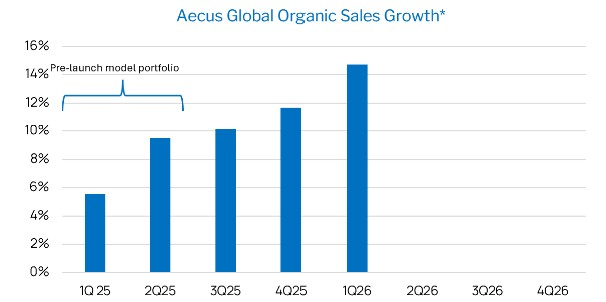
*Weighted average organic growth year-on-year. Defined as constant currency and excluding M&A.
A few highlights:
-
- Revenue growth at AWS, Amazon’s cloud computing division, accelerated to its fastest pace in over three years. The division’s backlog nearly doubled year-over-year, with backlog coverage at 30 months, 60% above its historical baseline levels.
- Three years post launch, Illumina placed a record number of NovaSeq X, its flagship gene sequencing instrument, for Q1. This highlights strengthening downstream clinical demand and a broadening recovery in biopharma capital expenditure.
- Cognex, the global machine vision specialist, reported more than 20% organic growth in Q1, driven by broad-based demand across the packaging, electronics, and semiconductor end markets. Quarterly profit was 20% ahead of consensus expectations.
Some disappointments:
-
- Mastercard, the payment giant, reported double-digit revenue growth and sustained margin expansion in Q1. However, management provided softer guidance, citing regional travel disruptions in the Middle East and rising expenses ahead of sporting events, including the FIFA World Cup.
- Graco, the North American fluid control specialist, missed consensus expectations for the second consecutive quarter. Management attributed the shortfall to temporary order phasing. The company must improve execution timely to restore investor confidence.
Portfolio Performance Update
The Fund’s Net Asset Value (NAV) increased by 21.8%1 in Q2, driven by a combination of robust earnings growth and valuation multiple expansion. The fund’s Next-Twelve-Months (NTM) Price-to-Earnings ratio expanded from 23.4x at the end of Q1 to 25.3x at the end of Q2, while underlying NTM earnings per share (EPS) grew by 12.7%.
The Fund outperformed the MSCI ACWI Index for both the second quarter and year-to-date periods. Information Technology was the primary contributor, despite the portfolio maintaining a slight relative underweight position. Our Healthcare overweight, paired with favourable stock selection, further drove the outperformance. The primary detractors in Q2 were exposures within information services and Asian consumer discretionary companies.
Top 5 contributors and detractors during Q2 2026:
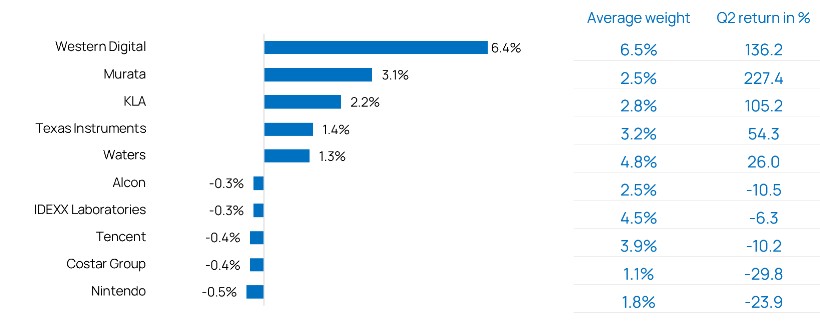
Source: Aecus Partners and LSEG Workspace as of 30/06/2026
Among the top contributors
-
- Western Digital, Murata, KLA, and Texas Instruments generated exceptional gains, propelled by robust data centre capital expenditure and strong semiconductor sales.
- Waters delivered strong performance, driven by the outperformance of its newly acquired BD Life Sciences assets, which exceeded initial integration expectations.
Among the top detractors
-
- Nintendo was under pressure in Q2 due to market concerns that elevated DRAM prices would compress console profit margins. However, we anticipate that management can mitigate this margin impact through moderate price increases.
- CoStar experienced another challenging quarter. In our view, investment in Homes.com has reached its peak, which should pave the way for free cash flow expansion.
- Tencent’s decision to accelerate artificial intelligence (AI) investments weighed on sentiment. Nevertheless, we maintain high confidence in the management team’s historical track record of disciplined capital allocation and expect similar execution going forward.
- Healthcare names, such as IDEXX and Alcon, remained deeply out of favour due to their exposure to discretionary consumer spending. Valuations have compressed to 10-year lows, limiting future downsides.
What have we been thinking about?
AI stocks have driven most market gains since the March bottom, as investors crowded into sectors with the strongest near-term momentum. Although growth potential is a core component within the “S” of our Defensible, Repeatable, and Scalable (DRS) framework, we place equal emphasis on the other two pillars to ensure our portfolio delivers sustainable double-digit returns.
The AI basket comprises 25–30% of the portfolio, focusing on semiconductor and data centre related businesses. We target market leaders exhibiting attractive long-term growth and margin profiles; critically, many of these holdings possess multiple secular growth drivers beyond AI.
A great example is Sumitomo Electric, which we added to the portfolio during Q2. Sumitomo is a key beneficiary of rising penetration of optical communication inside data centres, given its oligopolistic position in multi-core optical fibres and fusion splicers equipment. Furthermore, Sumitomo and AXT control over 80% of world’s indium phosphide substrate market, a critical material used to make communication grade lasers. Beyond AI, Sumitomo is a technological pioneer in high-voltage direct current cables for grid infrastructure and serves as a vital non-Chinese supplier of critical minerals such as tungsten.
We anticipate Sumitomo’s EPS growth should accelerate from middle-single-digit to over 20% for the foreseeable future. Notably, even without the AI tailwinds, we believe Sumitomo can compound its earnings at around 10%. Its current valuation of 21x P/E is highly attractive.
Our non-AI baskets account for over 70% of the portfolio and include companies in the Healthcare, Consumer, Industrial, and Information Services sectors. Despite a challenging macro environment, our non-AI holdings continue to deliver reliable, double-digit earnings growth.
For instance, driven by robust R&D investment, competitive market-share gains, and a highly resilient recurring revenue model, US industrial filter company Donaldson has accelerated its underlying revenue growth to high-single-digit. However, reported top-line expansion was temporarily masked by project timing and supply-chain constraints within its Aerospace and Defense division despite robust order backlogs. In addition, production migration to Mexico and legacy facility closures compressed near-term operating margins.
We expect many of these headwinds to reverse over the next two quarters, with gross margin expansion and operating leverage driving earnings growth well above historical averages. Furthermore, liquid cooling adoption at data centres could drive additional demand for Donaldson’s industry-leading bacteria filtration technology. Donaldson currently trades at 18x P/E, in line with its long-term average.
We observe similar fundamental improvements across numerous non-AI holdings. Yet, because capital markets remain narrowly focused on AI growth stories, compelling investment opportunities have emerged for our strategy, which remains committed to targeting unique, resilient business models capable of generating durable, long-term earnings growth at attractive valuations.
Macro from Micro
The cyclical recovery progressed as projected, but the surge in semiconductor sales was exceptional. May revenue for the sector more than doubled year-over-year, delivering a historically unprecedented expansion. Crucially, even excluding memory price inflation, growth surpassed 50%, signalling the strongest cyclical upswing since 2008.
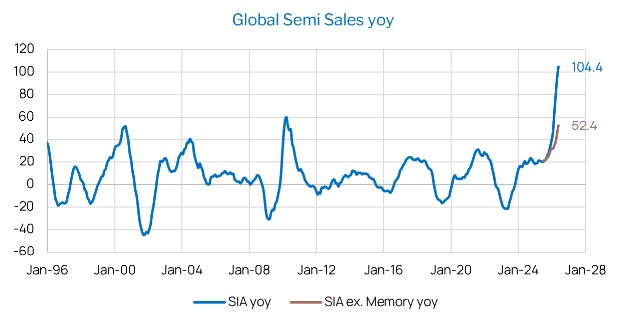
Source: Semiconductor Industry Association, Company Reports, Aecus Partners
This acceleration reflects an industry operating at full capacity to address technological challenges. Surging demand for compute has pushed existing technologies to the limits. Indeed, chip toolmaker Tokyo Electron’s CEO recently called for cross-border collaboration between Japan and its long-term rival South Korea, underscoring the urgency of these industry-wide constraints.
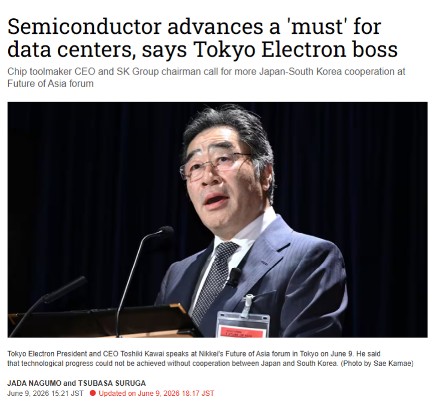
Source https://asia.nikkei.com/spotlight/the-future-of-asia/future-of-asia-2026/semiconductor-advances-a-must-for-data-centers-says-tokyo-electron-boss
We believe this sales acceleration is underpinned by robust volume demand rather than cyclical price increases arising from tight supply. This is evidenced by surging revenues among server supply chain companies with highly elastic production capacity, such as King Slide, whose monthly sales have more than doubled since April.
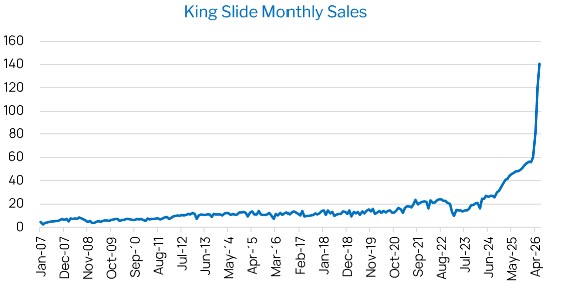
Source: company reports
Artificial Intelligence
The AI sector is accelerating fast, as billions of dollars in funding and top talent pour into the industry. We monitor the space through three lenses: technological progress, business potential, and societal impact.
Technological Progress
-
- Scaling continues at the frontier labs. The latest AI models, such as Anthropic’s Mythos and OpenAI’s GPT-5.6, display advanced capabilities triggering government debates over safety regulations and restricted access.
- The next generation of frontier AI models trained on Nvidia’s upcoming Vera Rubin chips, could deliver a step-change in cognitive capabilities, renewing the competition for compute. The emergence of the “agent economy” has driven insatiable demand for hardware, expanding beyond Nvidia GPUs to CPUs and DRAMs.
- In addition to Large Language Models, AI researchers are developing new frameworks like the World Model (understands real-world physics) and Adaptive AI (constantly learning). These alternative frameworks will remain exceptionally compute-intensive.
Commercial Potential
-
- AI advances along a non-linear “jagged frontier,” (below) meaning the technology organically grows into and creates new addressable markets rather than fitting legacy workflows. We believe continuous breakthroughs, headlined by OpenAI’s 96% reduction in inference costs between GPT-4 and GPT-5.5, will structurally improve unit economics and unlock new use cases.
AI’s Jagged Frontier
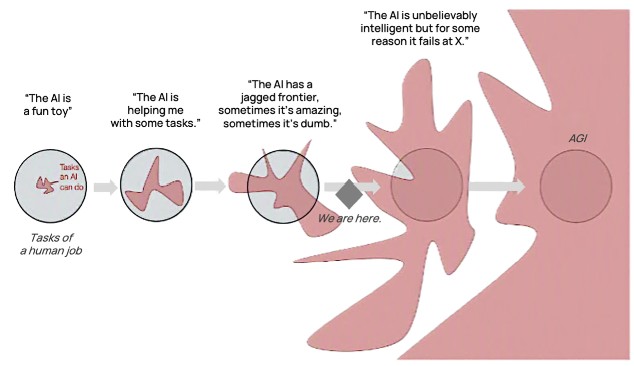
Source: https://x.com/tomaspueyo/status/1993360931267473662?s=20
- Strong adoption momentum continues across multiple industries. AI-generated tracks account for 15% of total music consumption and 50% of new content uploads on Deezer. In software development, 81% of codes submitted to Databricks databases are AI generated, while Amazon’s AI shopping assistant has doubled traffic-to-sales conversion rates (below). We expect these penetration curves to steepen as model utility progresses.
Amazon Conversion Rate
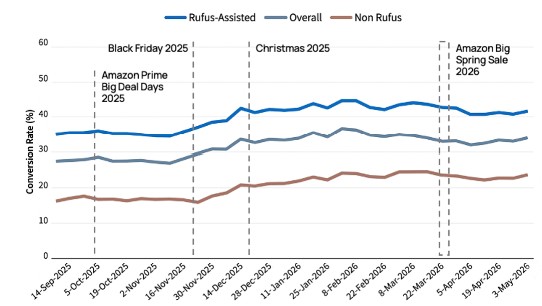 Source: https://sensortower.com/blog/state-of-ai-2026
-
- Current financial returns are highly polarised. Hardware companies and hyperscaler compute providers are highly profitable. In contrast, despite strong growth, model and application companies have yet to achieve profitability. However, if the user base is sticky and unit cost continues to fall, profitability could improve materially at the application layer.
Societal Impact
-
- The public debate around AI has intensified, shifting in a negative direction due to rising anxieties over jobs, wealth inequality, and national security.
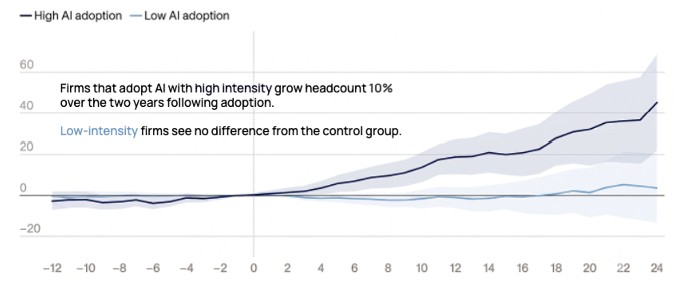
- Several major tech companies cut headcount by 15% to 20% in Q2 (see foot note[2]), likely driven by a weak consumer economy and rapid AI productivity gains. Counterintuitively, data from Ramp shows AI adopters are increasing headcount faster than AI laggards. It is unclear whether AI will create or destroy more jobs.
Total headcount rises after AI adoption
(effect on log headcount, months relative to adoption)
Source: https://ramp.com/data/heavy-ai-adopters-hire-more
-
- Because the financial gains from AI are heavily concentrated, public anxiety over wealth inequality is spiking. This has triggered contentious US political debates that are highly likely to persist; however, in the near term, technological advancement likely will remain the priority.
- Rising model capabilities have sparked urgent national security concerns. Current safeguards are inadequate and easily bypassed by adversaries, calling for a shift toward full ownership of data, models, and applications, which will further accelerate the US-China rivalry in AI development.
While public and political friction may create near-term noises, the structural trend remains unchanged. AI remains the most dynamic part of the global economy. The industry’s medium-term growth will continue to be aggressively fuelled by relentless innovation and capital expenditure.
Portfolio Moves
During the second quarter, we finetuned the portfolio to align with higher-growth, higher-quality segments of the economy, strictly guided by our DRS framework.
We initiated positions in market dominating businesses leveraged to the AI revolution: Belimo (fluid control), Mycronic (lithography/packaging), C Uyemura (electroless plating), and Sumitomo Electric (fiber optics/lasers). We funded these positions by taking profit in Hubble, Cadence Design, Graco and Amphenol. We exited Aon and Microsoft to mitigate exposure to areas facing potential AI disruption.
We topped up Amazon, Waters, and Donaldson and Nintendo on weakness, and trimmed Western Digital on strength.
Outlook
At the end of Q2, the average P/E multiple for the Fund was 25.3x, slightly above the 10-year average of 24.6x. Based on consensus estimates and Aecus TSR model, the portfolio is tracking to deliver double-digit compounded earnings growth for the next three years.
As market participants increasingly gravitate toward narrative-driven hype and narrow leadership, the investment case for owning resilient franchises with durable earnings power becomes even more compelling. We strive to maintain a healthy balance between structural competitive advantages, financial strength and valuation discipline, confident this framework will generate superior long-term returns for our investors.
We thank you again for your interest in the Fund and warmly welcome you questions and comments.
Until next quarter,
Fan, Arnaud and Alistair
[1] Aecus Global Equity Fund A USD ACC class
[2] Job cut: 4,500 at Paypal, 1,100 at Cloudflare, 3,000 at Intuit, 1,000 at Snap, 21,000 at Oracle, 8,000 at Meta.
Important Information
Issued by Aecus Partners SAS which is regulated by the Autorité des Marchés Financiers (AMF). RCS Paris n° 933 708 976 Agrément AMF n°GP20240027 (https://www.amf-france.org/fr, 17 place de la Bourse – 75002 Paris). The Fund is a sub-fund of the ICAV, an umbrella fund with segregated liability between sub-funds. The Fund is authorised by the Central Bank of Ireland as a UCITS pursuant to the European Communities (Undertakings for Collective Investment in Transferable Securities) Regulations. The ICAV has delegated UCITS management company functions to Aecus Partners SAS as its UCITS management company. The ICAV is authorised by the Central Bank of Ireland pursuant to the Regulations and the Central Bank (Supervision and Enforcement) Act 2013 (Section 48(1)) (Undertakings for Collective Investment in Transferable Securities) Regulations. The distributor of the Fund is Aecus Partners SAS. This financial promotion has been approved by Zeyro (FRN 1001386) on 15 April 2026. This Fund may be suitable for investors seeking long-term capital growth from Global equities, who can commit to a five-year investment horizon and tolerate medium volatility and potential capital loss. It is not suitable for investors requiring capital protection, guaranteed returns, or access to capital within five years.
This document is a communication for information purposes only intended for professional clients. Please refer to the Fund’s prospectus and key information document before making any final investment decision. These documents are available free of charge, in paper or electronic format, from the Fund’s Investment Manager, as well as on the Manager’s website: https://www.aecuspartners.com. This material may not be copied, reproduced, communicated or redistributed, in whole or in part, without prior authorisation from Aecus Partners SAS. Any entity responsible for forwarding this material to other parties takes responsibility for ensuring compliance with applicable financial promotion rules. This material does not constitute a subscription offer and cannot be equated with a recommendation or investment advice. This material is not intended to provide, and should not be relied on for, accounting, legal or tax advice. This material has been provided to you for informational purposes only and may not be relied upon by you in evaluating the merits of investing in any securities or interests referred to herein or for any other purposes. Any specific securities identified and/or described in this document do not represent all of the securities purchased, sold, or recommended for the Fund and no assumptions should be made that the securities identified and discussed were or will be profitable. The information contained in this material may be partial information and may be modified without prior notice. It is not individually tailored for or directed to any particular client or prospective client. Prospective investors should consult their financial adviser before making an investment decision. The sources used to carry out this reporting are considered reliable, however no warranty of accuracy or reliability is given and no responsibility arising in any other way for errors and omissions (including responsibility to any person by reason of negligence) is accepted by Aecus Partners SAS, its officers, employees or agents. Aecus Partners SAS accepts no responsibility for any direct or indirect losses caused by the use of the information provided in this document.
All data is as at the document date unless indicated otherwise. Performance data herein relates to the Aecus Global Equity Fund (the “Fund”). Net asset value performance (NAV) data has been calculated on a NAV-to-NAV basis and is net of management fees and operating expenses, with any income reinvested. A detailed description of the charges that apply is set out in the Prospectus. The ongoing charges figure may change over time. Company holdings and performance are likely to have changed since the report date. Company information, including performance calculations and other data, is provided by Aecus Partners SAS. Past performance may not be a reliable guide to future performance and investors may not get back the amount invested. If an investor’s own currency is different from the currency in which the Fund is denominated, the investment return may increase or decrease as a result of currency fluctuations. All investments involve risk. The value of the investment and the income from it will vary. The figures quoted relate to past periods and past performance is not a reliable indicator of future performance. The Fund uses the MSCI ACWI Net Index (source: MSCI) as a comparator benchmark to compare performance. The Fund is actively managed and is not constrained by any benchmark. Glossary of terms: please refer to the website. Access to funds of an ICAV managed by Aecus Partners SAS may be subject to restrictions regarding certain persons or countries.
EEA – Access to the Fund may be subject to restrictions regarding certain persons or countries. The Fund’s Prospectus and KIDs can be obtained by visiting www.aecuspartners.com/documents and are available in one of the official languages of each of the EU Member States into which the Fund has been notified for marketing under the Directive 2009/65/EC (the UCITS Directive). The Fund is currently notified for marketing into a number of EU Member States under the UCITS Directive.
UK – This Fund is a sub-fund of an Irish UCITS authorised by the Central Bank of Ireland and is not authorised by the UK Financial Conduct Authority (FCA). The Fund is recognised in the United Kingdom under the Overseas Funds Regime (OFR) in respect of certain share classes only. Only those share classes that have been recognised under the OFR may be marketed to investors in the UK. As an overseas fund recognised under the OFR, the Fund is not subject to UK sustainable investment labelling and disclosure requirements. The protections provided by the UK regulatory system, including access to the Financial Services Compensation Scheme (FSCS) and the Financial Ombudsman Service (FOS), do not apply. This document is for information purposes only and does not constitute an offer or solicitation to anyone in any jurisdiction in which such offer or solicitation is not authorised. Cancellation rights do not apply, and U.K. regulatory complaints and compensation arrangements may not apply. This material is issued and approved by Aecus Partners SAS which is authorised and regulated by the Autorité des Marchés Financiers (AMF).
Glossary of terms: please refer to the website
Contacts Aecus Partners: bonjour@aecuspartners.com – +33 (0)1 84 80 81 82 – 128 rue du Faubourg Saint-Honoré – 75008 Paris
Related insights






Insights
This section brings together Aecus Partners’ insights, perspectives and communications. It features a curated selection of content — podcasts, interviews, market updates and commentary — designed to share our views on portfolio companies and investment dynamics. These materials reflect our convictions at a given point in time, with the aim of providing a clear, structured and accessible perspective on complex topics.